
If you’ve recently spotted GEOD on CoinGecko, exchanges, or crypto communities, a few questions probably come to mind: What is GEOD? What is Geodnet? Is GEOD just another regular cryptocurrency? Why would a “positioning network” have anything to do with crypto? And does hitting the trending list mean it’s a good investment?
Here’s the one‑sentence take: GEOD is the native token of the Geodnet ecosystem, and Geodnet is a decentralized high‑precision positioning data network built on DePIN.
It’s not a meme coin, nor is it a concept token riding purely on hype. Geodnet aims to crowdsource hardware nodes from the community to provide high‑accuracy RTK positioning data for robotics, drones, autonomous driving, precision agriculture, AI systems, and more. Geodnet’s official positioning is “the global positioning network for an autonomous future,” delivering precise RTK data to robots, drones, and AI systems while rewarding contributors with GEOD tokens.
So, to really understand GEOD, you shouldn’t just watch its price charts. You need to grasp three things: first, why DePIN has become a hot crypto sector; second, what real‑world problem Geodnet’s positioning network actually solves; and third, whether GEOD can capture long‑term value from genuine data demand.
1. What Is GEOD? A One‑Sentence Explainer of Geodnet and the GEOD Token
Many newcomers searching “What is GEOD” treat it as just another new coin. But GEOD’s underlying logic is different from typical crypto assets.
GEOD is the utility token of the Geodnet network. Geodnet stands for Global Earth Observation Decentralized Network. According to the official docs, it’s a network that combines blockchain with RTK technology to deliver precise real‑time positioning data. Participants who contribute critical reference points earn GEOD rewards.
In simple terms, traditional GPS relies on satellite signals – your device receives satellite data and calculates its position. But standard GPS often gives meter‑level accuracy, which is fine for phone navigation but insufficient for autonomous driving, drone mapping, robotic navigation, precision agriculture, and similar use cases.
Geodnet’s goal is to provide higher‑accuracy correction data through distributed hardware nodes, enabling centimeter‑level positioning for devices.
1.1 What Is GEOD?
GEOD is the native token of the Geodnet ecosystem, serving three primary roles:
First, it incentivizes hardware node operators. Users buy and deploy a Geodnet Satellite Reference Station (the miner node). The station continuously receives GNSS satellite signals and uploads data; the network rewards contributors with GEOD based on data quality and location.
Second, GEOD can be used to pay for Geodnet’s RTK data services. The Geodnet documentation explicitly states that GEOD is a utility token for purchasing RTK data services and participating in governance.
Third, GEOD is tied to governance and ecosystem development. In a DePIN project, the token isn’t just a tradable asset – it also serves network incentives, service payments, and community governance.
So, GEOD’s value shouldn’t be judged solely by “price up or down.” Instead, watch whether the Geodnet network actually has nodes, coverage, data demand, paying customers, revenue, and a token burn mechanism.
1.2 Is GEOD a Regular Cryptocurrency?
No, GEOD is not a regular cryptocurrency.
It’s not a foundational blockchain asset like BTC or ETH, nor a meme coin like Dogecoin or PEPE, nor a pointless points‑based token. GEOD is closer to a DePIN infrastructure token – one that uses token incentives to build a real‑world hardware network.
Geodnet’s distinguishing feature: its network isn’t purely on‑chain; it connects physical hardware, satellite positioning data, mapping applications, robots, drones, and autonomous systems.
That’s the biggest difference between DePIN projects and typical crypto projects. Most on‑chain projects need only contracts, wallets, and liquidity. DePIN projects require real hardware deployment, physical coverage, data quality validation, and actual commercial customers.
Therefore, to assess GEOD’s value, look beyond the charts – examine whether Geodnet is generating high‑quality positioning data and whether that data is being used by real clients.
1.3 Why Has GEOD Gained Attention Recently?
GEOD’s recent spotlight comes from three converging narratives:
First, the DePIN sector is heating up. The market is refocusing on projects that connect to real‑world infrastructure – wireless networks, storage, GPU compute, sensor networks, and positioning data.
Second, AI, robotics, and autonomous driving are advancing. Future AI needs more than textual data – it needs real‑world data. Robots, drones, autonomous vehicles, AR devices, and industrial systems all require accurate location awareness.
Third, the value of real‑world data is rising. As AI systems move into the physical world, positioning, sensor, spatial, and IoT data become increasingly critical. Geodnet explicitly notes its network supports robotics, drones, autonomous vehicles, augmented reality, and the metaverse with precise navigation.
If you found GEOD on CoinGecko’s trending list, keep in mind: that list reflects short‑term market interest, search volume, trading activity, and price volatility – it does not mean the project has proven long‑term value.
2. What Is DePIN? Why Does Geodnet Fit Into This Hot Sector?
To understand GEOD, you must first understand DePIN.
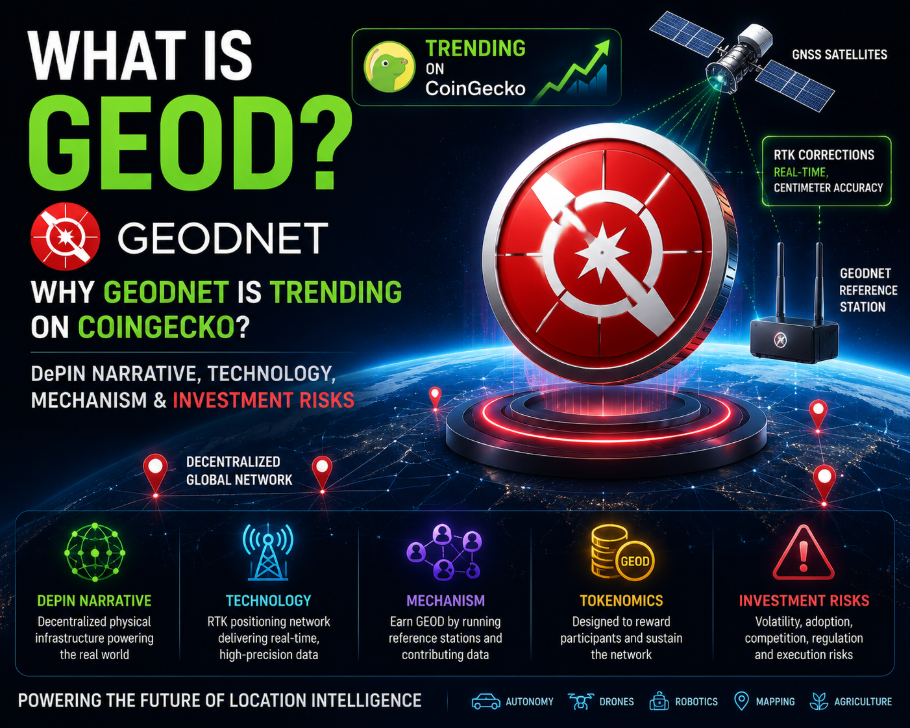
DePIN stands for Decentralized Physical Infrastructure Network. The core idea: use token incentives to get global users to contribute hardware, bandwidth, storage, compute, sensors, or data, thereby building a decentralized infrastructure network.
2.1 What Is DePIN?
Traditional infrastructure is built by large corporations – telecoms build cell towers, cloud providers build data centers, mapping companies collect road data, and positioning firms operate reference station networks. This model requires massive capital, expands slowly, and is controlled by a few large players.
DePIN flips that model. It distributes infrastructure building to participants worldwide via token incentives. Users buy hardware, deploy it in the real world, and provide services to the network; the network rewards them with tokens based on contribution quality. As coverage and service capabilities grow, businesses or end‑users purchase those services.
This is less like a traditional internet platform and more like “hardware crowdsourcing + token incentives + a real service network.”
2.2 What Problems Does DePIN Solve?
DePIN tackles three key issues:
High construction costs – Instead of a company bearing all capital expenses, DePIN distributes hardware deployment costs to global node operators, while the protocol coordinates growth.
Slow expansion – Building every city, region, base station, or sensor in‑house is slow. DePIN attracts community members to deploy devices across different areas, speeding up coverage.
Opaque incentives – Traditional infrastructure value is captured by platform companies; contributors are merely device providers or users. DePIN aims to let contributors share in network value through tokens.
Of course, there are downsides: token rewards can attract users who deploy purely for mining rather than real demand; if commercial revenue lags behind token issuance, the project may face sustained sell pressure.
2.3 What Type of DePIN Is Geodnet?
Geodnet falls into the location data infrastructure category of DePIN.
If Helium represents decentralized wireless, Filecoin decentralized storage, and Render decentralized GPU compute, then Geodnet represents decentralized high‑precision positioning data. Its core isn’t communication, storage, or compute – it’s providing RTK correction data to give robots, drones, agricultural machinery, surveying equipment, and autonomous systems much higher positioning accuracy.
This also distinguishes Geodnet from generic AI tokens. It doesn’t build AI models itself; it builds the positioning infrastructure that lets AI systems operate in the real world.
3. How Does Geodnet Work? Unpacking the GEOD Network Mechanism
Geodnet’s value comes from the network itself, not just token issuance. The basic loop: users deploy hardware reference stations, stations receive GNSS signals and upload data, the network generates RTK correction services, and those services are provided to robots, drones, surveyors, agricultural gear, and autonomous systems.
3.1 What Is Geodnet’s Hardware Node?
Geodnet’s hardware node is typically called a Satellite Reference Station or Satellite Miner. According to Geodnet’s product page, these stations receive signals from GPS, GLONASS, Galileo, BeiDou, and other GNSS constellations. Each reference station can deliver centimeter‑level RTK correction data to robots and devices within a 20‑to‑40‑kilometer range – about 100 times more accurate than standard GPS.
That means Geodnet’s network isn’t purely on‑chain; it depends on the geographic distribution and data quality of real‑world devices. A city or region with enough high‑quality reference stations will have usable RTK coverage. Too few nodes, poor location selection, or low data quality will limit network value.
3.2 What Is RTK High‑Precision Positioning?
RTK stands for Real‑Time Kinematic – a technique often called real‑time differential positioning.
Standard GPS errors are typically meter‑level – acceptable for phone navigation, but not enough for drone precision routes, autonomous lane‑level positioning, precise agricultural operations, or robotic navigation.
RTK uses a reference station to provide correction data, helping mobile devices cancel out satellite positioning errors to achieve centimeter‑level accuracy. That’s why RTK is crucial for robotics, drones, and autonomous vehicles:
- Drones doing surveying need precise positioning to avoid warped imagery and misaligned geographic tags.
- Autonomous vehicles need to know which lane they’re in – meter‑level GPS can’t deliver that.
- Agricultural machinery for seeding, spraying, and harvesting reduces overlap and improves efficiency with centimeter accuracy.
- Industrial robots, outdoor robots, and delivery bots require stable location awareness for path planning.
Geodnet aims to lower the cost and barriers to high‑precision positioning via DePIN.
3.3 Why Would Users Deploy Geodnet Hardware?
The immediate incentive is earning GEOD rewards. Geodnet’s website explains that users can purchase a Satellite Reference Station, install and optimize it, register it in the console, connect a wallet, and start earning GEOD. Reward rules depend on station location, data quality, and whether the node is in an under‑served grid cell.
This creates a classic DePIN economic model:
- Users buy hardware.
- Users contribute geolocation data.
- The network distributes GEOD based on contribution.
- Coverage grows, attracting data consumers.
- Data revenue, in turn, supports the token economy.
Geodnet also states that 80% of data revenue is used to buy back and burn GEOD tokens – a deflationary mechanism that permanently reduces supply, designed to incentivize network growth.
That’s an important part of GEOD’s investment thesis – but don’t assume “buyback and burn” guarantees price appreciation. The real keys: is data revenue growing sustainably, is the revenue scale meaningful, and is token issuance pressure under control?
4. Why Did GEOD Top CoinGecko’s Trending List? Analyzing Market Attention
When GEOD appears on CoinGecko’s trending list, many assume it signals an imminent breakout. But the trending list more accurately reflects a surge in short‑term attention.
4.1 What Does the CoinGecko Trending List Indicate?
CoinGecko trends typically capture spikes in user searches, page views, trading activity, price volatility, and community discussion. It means more people are looking at the project – but it doesn’t mean fundamentals have been validated.
According to CoinGecko data (as of July 27, 2026), GEOD had a market cap of about $133 million, ranked ~223rd, with 24‑hour volume of roughly $4.3 million. The page also showed GEOD up about 39% in 24 hours and 49% over 7 days. Those figures explain the search spike: near‑term price gains, volume expansion, and the DePIN narrative converging to draw more eyeballs.
But let’s be clear: trending is an attention metric, not a safety metric. Many assets hit the list after a sharp run‑up, only to correct just as quickly.
4.2 Key Drivers Behind GEOD’s Price Move
GEOD’s recent attention likely comes from these drivers:
First, renewed interest in DePIN. After multiple crypto cycles, investors are looking for projects with a tangible infrastructure rationale. Compared to purely narrative‑driven tokens, DePIN offers a more concrete value framework: hardware nodes, network coverage, real services, and commercial revenue.
Second, stronger AI and robotics narratives. AI won’t stay confined to chat windows forever. As it moves into robots, cars, drones, industrial equipment, and real‑world services, any system that perceives the physical world needs location, spatial, sensor, and positioning data.
Third, Geodnet has clear real‑world applications. Its website emphasizes RTK data services for robots, drones, and AI systems, and each reference station can cover 20‑40 km with centimeter accuracy. That makes it easier for investors to connect GEOD to tangible use cases.
Fourth, short‑term market data improved. CoinGecko shows a significant volume increase – the page noted 24‑hour volume up over 1,000% day‑over‑day, indicating elevated market activity. Volume spikes often attract short‑term traders and more attention.
5. What Value Does the GEOD Token Have? Where’s the Investment Thesis?
To assess GEOD’s investment potential, don’t just ask “has it gone up?” Ask: why does the token exist? Why does the network need GEOD? Can GEOD capture value from a real data network?
5.1 What Are GEOD’s Use Cases?
Layer 1 – Network incentives. Miners/node operators earn GEOD by deploying hardware and providing quality positioning data – this fuels network bootstrapping and expansion.
Layer 2 – Service payments. Geodnet’s documentation shows GEOD can be used to pay for RTK data services. If more robots, drones, surveyors, agricultural firms, or autonomous systems purchase Geodnet data, GEOD gains a clear demand driver.
Layer 3 – Governance. GEOD holders can participate in governance, influencing ecosystem direction. While governance alone may not boost price, it gives the token a functional role in a decentralized network.
5.2 Does GEOD’s Value Derive from Real Revenue?
This is the most critical question for GEOD. Many DePIN projects see fast node growth and token hype early on, but long‑term viability depends on whether real customers are willing to pay for the service.
For Geodnet, investors should focus on these questions – not just “more nodes = higher price”:
- Is data usage increasing?
- Does the RTK service have consistent paying customers?
- Is commercial revenue actually growing?
- Can revenue absorb token issuance pressure?
- Does the buyback‑and‑burn mechanism create a virtuous cycle?
- Is node coverage concentrated in areas with genuine demand?
If the network has many nodes but few clients, GEOD may face a scenario where miners sell tokens while real demand remains weak. If node growth, data quality, enterprise adoption, revenue, and token burn all move in sync, then GEOD’s long‑term logic becomes more solid.
5.3 How Is GEOD Different from Typical AI Tokens?
GEOD isn’t an AI model token – it’s infrastructure for AI to operate in the physical world. Typical AI tokens revolve around model training, generative content, smart assistants, compute markets, or trading bots. GEOD is about physical data networks. Its core isn’t “can AI write an article?” but “can robots, drones, and autonomous devices get accurate location data?”
This makes GEOD more like the infrastructure behind AI infrastructure. If future AI agents live mainly on screens, GEOD’s role may be limited. But if AI moves into cars, robots, drones, agricultural gear, AR glasses, and industrial settings, high‑precision positioning grows in importance.
6. GEOD’s Long‑Term Growth Logic: Why AI, Robotics, and Autonomous Driving Matter
GEOD’s long‑term narrative ties to a bigger trend: AI moving from the digital world to the physical world.
When AI only answers questions in web and mobile apps, it mainly needs text, images, code, and databases. But when AI enters robots, drones, vehicles, and industrial equipment, it must understand physical space.
6.1 Why Do Robots Need High‑Precision Positioning?
To perform tasks, robots must know where they are, where the target is, the path, and obstacles. Indoor robots can rely on vision, radar, SLAM, etc., but for large‑scale outdoor scenarios, high‑precision GNSS and RTK remain essential.
- Agricultural robots must follow precise field routes.
- Delivery bots need stable navigation on campuses or roads.
- Drones require accurate flight paths for inspection, shooting, or mapping.
- Autonomous vehicles need lane‑level positioning for path planning.
Inaccurate positioning can cause missed routes, repeated work, deviations, or even safety incidents. So, high‑precision positioning isn’t a nice‑to‑have – it’s foundational for many automated systems.
6.2 Why Does the AI Agent Era Need Real‑World Data?
AI agents aren’t just chat assistants – they could become real‑world task executors. They’ll need to pull map, location, sensor, weather, traffic, inventory, pricing, device status, and other data to complete physical tasks.
For example, an agricultural AI planning a spraying route needs equipment position, field boundaries, terrain, and deviation data. A drone inspection AI checking power lines needs flight paths, geographic coordinates, image geo‑tags, and error margins. An autonomous driving system determining lane position needs high‑precision maps and positioning data.
All these scenarios show that future AI requires not just internet data, but real‑world data. Geodnet sits right at the intersection of AI + location + DePIN.
6.3 Which Industries Could Geodnet Benefit?
Potential beneficiaries include autonomous driving, drones, precision agriculture, robotics, surveying, augmented reality, digital twins, and IoT.
- Autonomous driving: high‑precision positioning aids lane‑level navigation.
- Drones: RTK boosts route accuracy, surveying quality, and image geotagging.
- Smart agriculture: precise positioning reduces waste in seeding, fertilizing, spraying, and harvesting.
- Robotics: positioning supports outdoor inspection, delivery, cleaning, and security.
- AR and digital twins: accurate spatial positioning lets virtual information overlay seamlessly onto the real world.
These applications don’t guarantee GEOD’s price will rise, but they show Geodnet’s technical direction has genuine real‑world demand.
7. GEOD Investment Risks: The Biggest Challenges for DePIN Projects
GEOD has narrative and application potential, but it remains a high‑risk crypto asset. DePIN risks go beyond price volatility – they include hardware, network, commercialization, and tokenomics challenges.
7.1 Hardware Expansion Risk
DePIN depends on hardware deployment. If device costs are high, installation complex, maintenance expensive, or rewards decline, user willingness to deploy nodes may drop.
Geodnet reference stations need to be physically placed in suitable locations and kept running reliably. Each station uploads about 10‑20 GB of data per month – low‑power and no RF transmission, but it still requires internet connectivity, a permanent installation spot, and consistent operation. Uneven coverage could lead to dense nodes in some areas and under‑served zones where commercial demand actually exists.
7.2 Commercial Demand Risk
The most common DePIN pitfall: having a network doesn’t mean having revenue. Many users deploy nodes because they earn token rewards – but whether enterprises will consistently purchase data services is a separate question.
If Geodnet’s data usage and commercial revenue grow slowly, GEOD may face sell pressure that outpaces real demand. Investors should track:
- Is the RTK data service being used by customers?
- Is usage growing?
- What industries are customers from?
- Can revenue support the token economy?
- Is the buyback actually funded by data revenue, not short‑term marketing?
7.3 Tokenomics Risk
GEOD’s price is also affected by token supply dynamics. CoinGecko shows a max supply of 1 billion GEOD and a circulating supply of about 450 million. The gap between market cap and FDV means future unlocks, miner rewards, team/investor allocations, ecosystem grants, and burn rates will all influence price.
Even if the project direction is right, excessive token issuance could pressure prices.
7.4 DePIN Competition Risk
Competition in DePIN is intensifying. Helium, Filecoin, Render, IoTeX, and others already have strong brand recognition across different infrastructure verticals. More positioning, sensor, robotics, and AI‑physical‑infrastructure projects will emerge. Geodnet needs to prove its edge in data quality, coverage, cost, customer adoption, developer tools, and partnerships. If competitors offer cheaper, more stable, or easier‑to‑integrate services, Geodnet’s commercialization may slow.
7.5 Market Cycle Risk
GEOD is still a crypto asset, influenced by BTC’s trend, overall liquidity, DePIN narrative momentum, exchange listings, macro rates, and risk appetite. Even if fundamentals improve, short‑term price can drop due to broader market declines. So don’t treat GEOD as low‑risk, and don’t ignore volatility just because it has a real‑world use case.
8. How to Think About GEOD Price Predictions
Many search for “GEOD price prediction” hoping to know if it will keep rising. A better approach isn’t to set a fixed target – it’s to build a framework for price drivers.
8.1 What Conditions Would Support a Sustained GEOD Price Increase?
For GEOD to appreciate over the long term, several factors usually need to align:
First, network growth – node count, coverage area, data quality, and availability must improve. Without a high‑quality network, commercial clients won’t stay.
Second, commercial revenue growth – miner rewards alone aren’t enough; enterprises and developers must actually purchase RTK data services. Stronger real revenue makes the token economy more self‑sustaining.
Third, an effective burn or consumption mechanism – Geodnet’s stated 80% revenue‑to‑buyback‑and‑burn could enhance value capture if revenue scales. But if revenue is small, the impact on price will be limited.
Fourth, sustained DePIN market interest – if DePIN becomes a major 2026 crypto theme, GEOD may attract sector‑level capital. If narratives shift elsewhere, attention may fade.
Fifth, BTC and overall market stability – most altcoins can’t decouple from the broader market. A sharp BTC drop will likely drag GEOD down.
8.2 Price Predictions Shouldn’t Rely on Charts Alone
For DePIN projects, the real indicators are network data. Watch:
- Miner count growth.
- Number of countries/regions with coverage.
- RTK usage volume.
- Data revenue trends.
- New customer partnerships.
- Token unlock schedules and burn rates.
- Trading volume and liquidity health.
If price rises while network metrics stagnate, risk increases. If price fluctuates but adoption keeps growing, the long‑term case becomes more robust. So treat “GEOD price prediction” as an observation framework, not a buy/sell signal.
9. How Does GEOD Compare to RWA and Tokenized Stocks?
Crypto now features different asset types. GEOD is DePIN infrastructure – not RWA or tokenized stocks.
DePIN represents real‑world infrastructure networks – positioning, wireless, storage, compute, sensors, energy, etc.
RWA and Tokenized Stocks represent traditional financial assets on‑chain – stocks, ETFs, bonds, gold, etc., as tokenized expressions.
GEOD is about building a high‑precision positioning data network. Tokenized stocks are about expressing traditional equity via tokens. Both connect to the real world, but in fundamentally different ways.
To explore RWA and tokenized stocks further, check these Hibt resources (with /zh-cn removed from the URLs as requested):
- For Oracle‑related tokenized stocks: What is ORCLB
- For Nasdaq‑related tokenized assets: What is TQQQB
- For Marvell Technology tokenized assets: What is MVLLB
- For Micron tokenized assets: What is MUUB
- For more RWA examples: What is SNXXB
That gives you a broader crypto asset framework:
- GEOD → DePIN infrastructure
- ORCLB, MVLLB, MUUB, SNXXB → RWA and tokenized stocks
- ETH → public blockchain infrastructure
- BTC → crypto store‑of‑value narrative
In the future, crypto may no longer be just “buying coins” – it will increasingly cover infrastructure, data networks, real‑asset mapping, AI systems, machine economics, and global financial markets.
10. How to Buy GEOD – A Beginner’s Guide to Participating
If you want to buy GEOD, first understand: you’re buying a highly volatile crypto asset – not Geodnet company stock, and not a risk‑free yield product.
10.1 What to Know Before Buying GEOD
At minimum, research four things:
First, what GEOD is used for – network incentives, RTK service payments, and governance – not just hype.
Second, market risk – GEOD is an altcoin with much higher volatility than BTC or ETH.
Third, liquidity – check exchange order book depth, bid‑ask spreads, and 24‑hour volume.
Fourth, DePIN understanding – if you don’t grasp the link between hardware nodes, data networks, token incentives, and commercial revenue, don’t go heavy.
CoinGecko shows GEOD is tradable on both centralized and decentralized exchanges, with active markets including Raydium, Coinbase Exchange, Gate, Quickswap, and MEXC. Available platforms vary by region and time – always check real‑time listings.
10.2 How to Trade GEOD
A typical flow for beginners:
- Prepare USDT or another supported base asset.
- Choose a platform that offers GEOD trading.
- Navigate to a GEOD pair, e.g., GEOD/USDT or GEOD/USDC.
- Place a market or limit order.
- After purchase, you can keep it on the exchange or transfer to a self‑custodial wallet.
Crucial: If withdrawing to a wallet, double‑check the chain, contract address, and wallet network. Sending on the wrong chain can result in permanent loss.
For short‑term trading, focus on volume, slippage, and stop‑losses. For long‑term holding, track fundamentals, token unlocks, and network revenue.
11. Who Is GEOD Suitable For?
GEOD fits three investor profiles:
- Long‑term DePIN believers – those who think crypto will increasingly connect to real‑world infrastructure.
- Investors focused on AI + infrastructure – who understand the need for high‑precision positioning in robotics, drones, autonomous systems, and IoT.
- Those who can analyze tokenomics – not just price, but network growth, revenue, unlock schedules, burns, and usage data.
GEOD is not suitable for:
- Short‑term hype chasers – buying just because it’s trending often leads to buying high and selling low.
- Investors who can’t handle high volatility – even with solid fundamentals, GEOD can swing sharply.
- Those who don’t understand DePIN mechanics – without knowing how node rewards, data demand, and token issuance interact, it’s hard to assess risk.
12. Conclusion: Is GEOD a DePIN Opportunity or Just Hype?
GEOD is neither a meme coin nor a pure AI concept token. Behind it is Geodnet – a DePIN positioning data network that aims to use community‑deployed satellite reference stations to deliver high‑precision RTK data for robotics, drones, autonomous vehicles, precision agriculture, and AI systems.
GEOD’s opportunity rests on three pillars:
- DePIN is regaining market attention.
- AI and robotics moving into the real world need reliable spatial positioning.
- Geodnet has a relatively clear model – hardware nodes, data services, and token incentives.
But its challenges are equally clear:
- Hardware networks require ongoing expansion and maintenance.
- Commercial revenue must be proven – not just mining rewards and sentiment.
- Token unlocks, inflation, liquidity, and market cycles all affect price.
- DePIN competition will only intensify.
So, judging whether GEOD is a worthwhile investment shouldn’t be based on a CoinGecko trending listing or a short‑term rally. More important: is the network growing? Is RTK data being used by real customers? Is revenue improving? Is the token economy healthy?
GEOD represents an interesting DePIN infrastructure direction – but it remains a high‑volatility crypto asset. Investors should assess their own risk tolerance, and nothing here should be taken as financial advice. Don’t buy blindly just because of short‑term hype.
The people best suited to study GEOD aren’t those chasing the next hot ticker – they’re those willing to understand DePIN, RTK positioning, real‑world data needs for AI, and token economic models.